

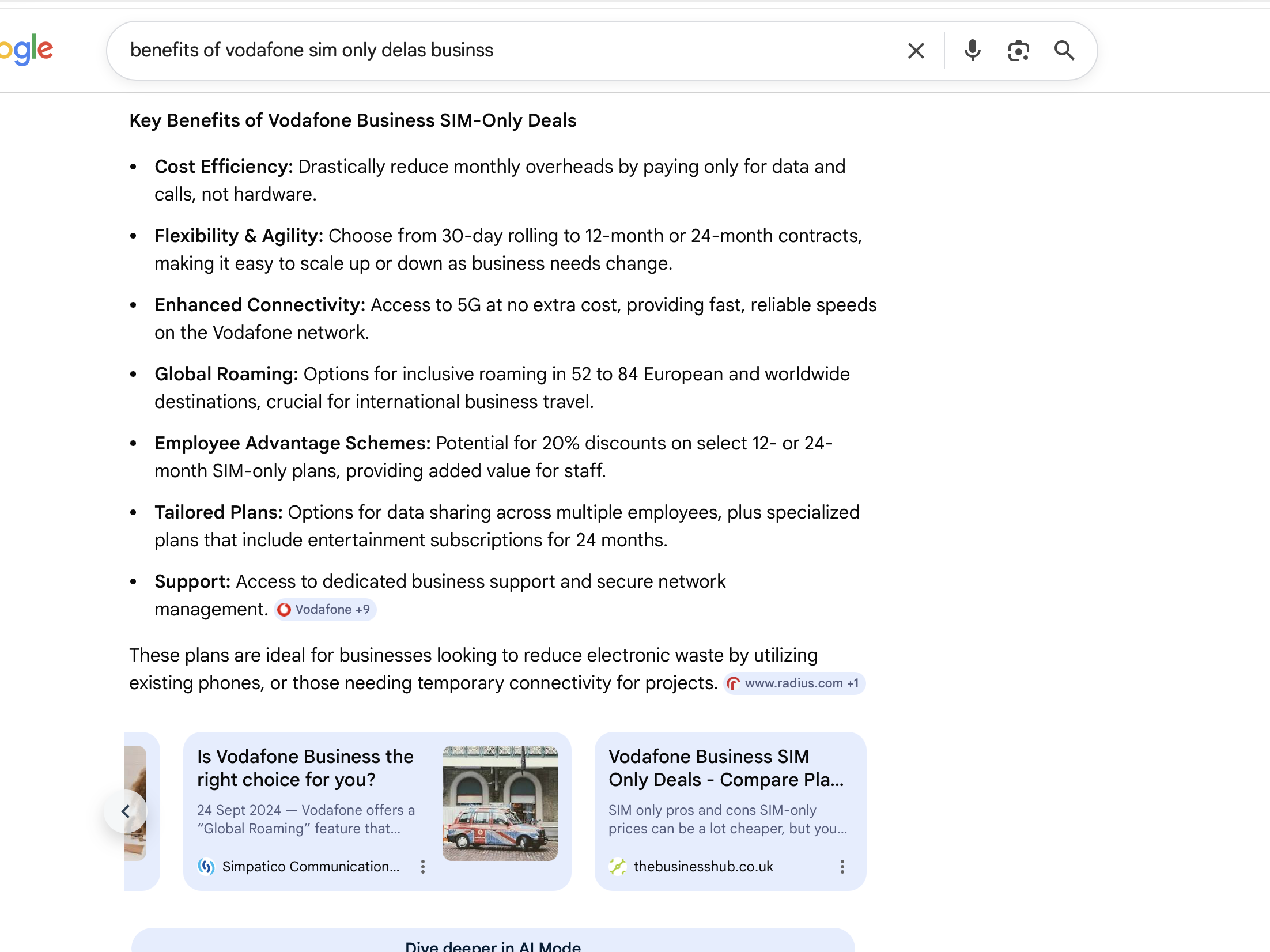
With the rise of AI overviews in search results, the strategies for attracting and converting visitors are changing. This article explores how ttraditional SEO with AI-driven insights creates a robust traffic generation plan, ensuring your content stands out and delivers tangible results. It's about planning content creation, structural considerations, and the critical role of human oversight in an AI-assisted workflow.
Strategic Planning for AI Overviews and SEO
Effective traffic generation begins with a well-defined strategy. Understanding your audience, their search intent, and how AI overviews might influence their journey is crucial. This involves a deeper dive into keyword research and competitor analysis, moving beyond traditional metrics. We use tools like AHRefs, GA4 and our best toolkit, our human brains to plan and then execute content that gives both quality and volume of traffic.
Understanding Search Intent in AI
AI overviews aim to provide concise, direct answers to user queries. This means your content needs to be structured to offer clear, authoritative information that an AI can readily extract and summarise. Focus on informational and transactional intent, ensuring your content addresses specific questions and provides actionable solutions.
But don't forget that you must answer the human customer's question, in a format they can digest, and provide value they can't get elsewhere. It's about combining your business' secret sauce with a tech structure that helps you get the message out there help buyers to find you.
Informational Intent: Users seeking answers to questions (e.g., "how to," "what is"). Your content should provide comprehensive, well-structured answers to questions users are asking
Transactional Intent: Users looking to make a purchase or take a specific action. Optimise for clear calls to action and direct solutions.
Navigational Intent: Users looking for a specific website or page. Ensure your brand name and key pages are easily discoverable.
Authority and Expertise: AI overviews and AI are kind of like traditional SEO with more structure bolted on.There's no long-term point in just regurgitating info that is already available. You might get a quick boost, but you'll also quickly lose the positions if you re not providing any value for the user.
Advanced Keyword Research and Gap Analysis
Traditional keyword research remains vital, but with AI overviews, it's essential to identify answerable keywords and phrases - those likely to trigger an AI summary. Look for long-tail queries, comparative searches, and questions that indicate a user is seeking a definitive answer. Perform a gap analysis to identify topics where your competitors are ranking for AI overviews and where you can create superior, more comprehensive content. You can tools like AHRefs or SEMRush to support this.
Consider the types of questions your target audience asks that could be answered directly by an AI overview. For instance, if you're in financial lead generation, questions about "best investment strategies for beginners" or "how to choose a mortgage" are prime candidates. Your content should aim to be the definitive source for these answers.
Content Creation: Clarity and Authority
The quality of your content is the cornerstone of both SEO and AI overview success. Content needs to be accurate, comprehensive, and presented in a way that is easily digestible by both humans and AI algorithms. AI will not get the right answer every time. It will contradict itself from one post to the next. That's why we use a human-in-the-loop solution. You can create much more volume without a human. But if quality matters, and it does, and compliance is vital like in Financial Serviced or Healthcare, then you must get a sign off from a real person.
Structuring Content for AI Extraction
AI overviews are designed to quickly grasp the essence of your content. This necessitates a clear, logical structure. Use headings (h2, h3) to break down complex topics into manageable sections. Employ bullet points, numbered lists, and tables to present information concisely. Ensure your introductory and concluding paragraphs summarise the key takeaways effectively.
For example, when discussing boosting landing page conversion rates, you might have an h2 for "Key Elements of a High-Converting Landing Page," followed by h3s for "Compelling Headline," "Clear Value Proposition," and "Landing Page Call to Action," each with bulleted explanations.
The Role of E-E-A-T in AI Overviews
Expertise, Experience, Authoritativeness, and Trustworthiness (E-E-A-T) are more critical than ever. AI overviews prioritise content from credible sources. Ensure your content is factually accurate, backed by data, and written by and attributed to experts. This builds trust with both users and search engines, increasing the likelihood of your content being featured in an AI overview.
Showcasing your agency's 40 years of combined experience in areas like B2B and B2C lead generation, email marketing, and link building can significantly bolster your E-E-A-T. Highlight case studies, client testimonials, and industry recognition within your content where appropriate. But don't be generic. This article will not be a perfect example. But there isn't a perfect example.
Here's a breakdown of content types and their suitability for AI overviews:
Content Type | Description | AI Overview Suitability | Optimisation Tips |
|---|---|---|---|
How-To Guides | Step-by-step instructions for a specific task. | High | Use numbered lists, clear headings, and concise language.SE |
SEO Definitive Guides | Comprehensive explanations of a topic. | Medium to High | Structure with clear sections, summaries, and strong topic sentences. |
SEO Comparison Articles | Analysing and contrasting different products/services. | High | Employ tables for easy comparison, highlight key differences. |
FAQ Pages | Direct answers to common questions. | Very High (but changing Google has recently dropped support for FAQs but others still follow) | Each question should have a concise, direct answer. |
AI content case Studies | Detailed examples of problem-solving and results. | Medium | Summarise key outcomes and methodologies clearly. |
AI-Assisted Content Creation with Human Oversight
Using AI in your content workflow can significantly enhance efficiency, but it must be complemented by human expertise to ensure quality, accuracy, and brand voice.
AI as a Content Generation Assistant
AI tools can assist with various stages of content creation, from generating initial outlines and drafting sections to suggesting keywords and optimising for readability. For instance, AI can help in structuring an article on supercharging Google Ads ROI by suggesting key areas to cover, such as bid management, ad copy optimisation, and audience targeting.
Outline Generation: AI can quickly create a logical structure based on your topic and target keywords.
Source referencing at scale: If you have unique data or external services with an API connection, you can use these to enhance the quality of your writing. Inject real data, live updates, and keep it on point 24/7.
Drafting Initial Sections: For common or factual topics, AI can generate initial drafts, saving significant time.
Keyword Integration: AI tools can suggest natural ways to incorporate target keywords and related phrases.
Readability Enhancement: AI can analyse text for clarity, conciseness, and overall readability, making it more accessible to a wider audience.
Structured Data: This is perfect for AI. Putting the H1, H2, H3 headers in and describing your table schema correctly are perfect roles for AI or machine learning.
Image Generation: With clear instructions and guard rails, AI can produce high-quality images. Without them, expect generic AI dross that is obvious.
The Role of the Human Editor. Being Human.
While AI can accelerate content creation, human editors are crucial for ensuring accuracy, maintaining brand voice, and adding the nuanced understanding that only a human can provide. A human editor will:
Verify Factual Accuracy: Cross-reference key information generated by AI to ensure it is correct and up-to-date.
Refine Brand Voice and Tone: Ensure the content aligns with your business' unique voice and resonates with your target audience.
Nuance and Depth: Inject insights, examples, and perspectives that AI cannot replicate, especially in complex areas like financial lead generation, helathcare etc. Even if you create a document for AI to reference on your business, it still is just a brief. It doesn't know the APR has juts changed. It doesn't know that a particular laser brand is the most popular just now.
Optimise for E-E-A-T: Enhance the content's expertise, authoritativeness, and trustworthiness through expert commentary and real-world examples.
Ensure Ethical and Responsible Content: Review for any biases, inaccuracies, or potentially harmful content that AI might inadvertently generate.
Here’s a practical workflow for AI-assisted content creation:
Stage | AI Role | Human Editor Role |
|---|---|---|
Research & Planning | Keyword suggestions, topic clustering, competitor analysis. Data gathering including unique, fresh data or data combinations Test and iterate tools. | Validate keyword relevance, define content strategy, identify unique angles and data points to match user queries. |
Outline Generation | Generate initial article structure, suggest headings and subheadings. | Refine structure, ensure logical flow, add specific points of focus. |
Content Drafting | Generate initial paragraphs, expand on specific points. | Rewrite for clarity, accuracy, brand voice; add unique insights and examples. |
Optimisation | Suggest SEO improvements, readability enhancements. | Finalise SEO elements, ensure natural language, check for E-E-A-T. |
Proofreading & Approval | Removing AI tells. Stop crafting and start writing! | Final review for factual errors, tone, style, and overall quality. |
Measuring and Iterating
Generating traffic is an ongoing process that requires continuous monitoring and adaptation. Use analytics to understand how your content performs in both traditional search results and AI overviews. Change your best content regularly as it quickly decays in importance.
Leveraging Analytics for AI Overview Performance
Monitor your search console data for impressions and clicks related to AI overviews. While direct metrics for AI overview performance are evolving, there is pretty robust data available in tools like AHRefs and SEMRush, Microsoft Clarity have just introduced a new service to support this too and also GA4 of course, but this has low fidelity.
Did We Say Refine?
Based on your performance data, continuously refine your content strategy. If certain topics consistently appear in AI overviews, double down on creating more in-depth, authoritative content in those areas. If content isn't performing as expected, revisit its structure, clarity, and E-E-A-T factors. Remember, the digital landscape is dynamic, and your strategy should be too. This iterative approach is central to our philosophy at The Fractions, where we develop and deliver winning strategies based on real data & KPIs while continuing to iterate, improve, and grow.
Conclusion
Creating quality traffic from AI overviews and SEO requires a strategic, data-driven approach that blends the efficiency of AI with the irreplaceable insight of human expertise. By focusing on clear, authoritative, and well-structured content, you can position your brand to capture attention in both traditional search results and AI products.
And if you need some help, contact us to find out more and view our case studies.